Mercosur celebrates the signing of the agreement with the European Union: “It is a historic moment”.”
Green light to the pact that will create the largest free trade zone in the world, with more than 720 million consumers.
 EN
ENIn the Argentine market, multiple financial instruments are traded that allow you to “invest in the countryside” easily and with little money.
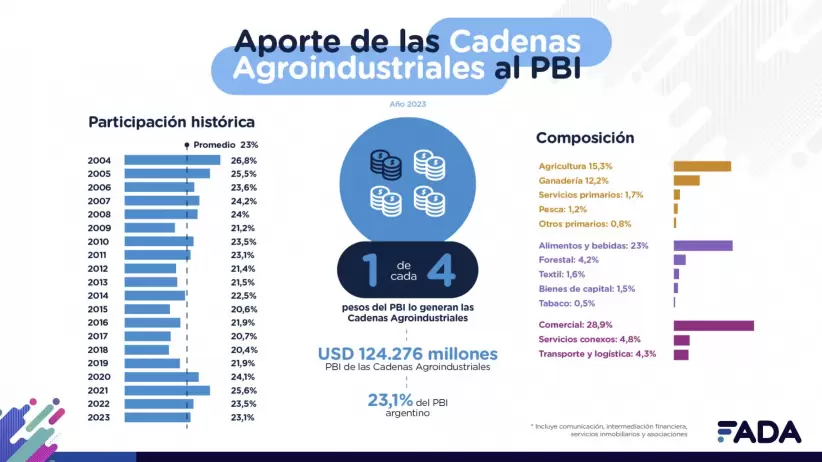
Agriculture is one of Argentina's most important industries.. In fact, according to the latest report by the Agricultural Foundation for the Development of Argentina (FADA), “The countryside” contributed more than 23% to the country's gross domestic product (GDP) in 2023., that is, around US$124 billion.
Of the total, most came from agriculture, which generated 15.31% of GDP. This was followed by livestock farming, with 12.21% of GDP; primary services, with 1.71% of GDP; and fishing, with around 1.21% of GDP.
Over the last 20 years, the share of rural production has always been above 20%., with an average of 23% and a peak of almost 27%. Basically, $1 of every $4 of GDP came from agro-industrial chains.
Given the importance of the sector, Many savers and investors seek to participate in it to obtain financial gain., but they believe they must be millionaires to do so. Big mistake. In the Argentine market, multiple financial instruments that allow you to “invest in the countryside” easily and with little money.
“Today, there are various digital investment platforms that allow you to invest in agriculture without having to purchase a hectare of land for production. There are productive trusts that offer the possibility of entering the agricultural value chain with minimal capital.”, he commented Omar de Lucca, economic consultant and financial director of Agropecuaria Surmax.
These financial trusts operate in a similar way to mutual funds: The management company collects capital from various participants and invests it in certain activities to generate a profit that is distributed periodically..
In these cases, it is important to note that they are not usually ultra-liquid. “As these are closed-end funds, units cannot be redeemed at any time, as is possible with open-end funds. This means that the investment must be maintained until the exit date previously stipulated in the prospectus, with no possibility of early redemption.”, clarified Matías Kostendt, wealth advisor at Bull Market Brokers.
To make a good choice when investing in these vehicles, De Lucca recommended search for references for each company, its track record in the market, and the competitive advantages of vertical integration.
“I always recommend seeking personalized advice from the company. It is important to be able to meet the people behind a platform or website in person. Personalized advice makes potential investors feel more confident and helps them make quicker decisions.”, said the specialist.
On the other hand, more aggressive investors can invest directly in some companies that are part of the country's agro-industrial chain through the purchase of its shares.
“On the local market, you can trade shares in leading companies such as Cresud, San Miguel, Molinos Agro, Agrometal, Ledesma, Carlos Casado, Juan Semino, among others, and there are also CEDEARs, such as Bioceres and Adecoagro.”, Kostendt pointed out.
Here You also have to be very careful with liquidity.. “Although the agricultural sector is the main generator of foreign currency entering the country and is generally very productive, some of these companies do not have sufficient liquidity to trade these securities if they want to invest a significant amount of money. For this reason, it is advisable to invest gradually, and to do the same when unwinding positions in order to mitigate any price volatility that may exist.”, said the financial advisor.
Finally, on the local stock exchange, you can also purchase bonds issued by certain companies in the agricultural sector, such as those of Cresud or San Miguel, for example, which may be hard dollar or dollar-linked, depending on the particular asset.
Forbes
https://www.forbesargentina.com/money/economia-real-principiantes-como-invertir-el-campo-n53293